
If you have been putting off your first yoga class because you are not flexible enough, not fit enough, or not sure what you are walking into, you are in…
TL;DR
Your first yoga class should include a warm-up, breath-coordinated movement, and a final rest period; for beginners, a Gentle or Therapeutic class is the best starting point because it meets your nervous system where it actually is.
If you have been putting off your first yoga class because you are not flexible enough, not fit enough, or not sure what you are walking into, you are in good company. Most people who eventually find their way onto a mat spent months or years talking themselves out of it first. So let's skip the sales pitch and actually answer the question: what should you expect in your first yoga class?
The honest answer is that your first yoga class will probably feel a little awkward, a little unfamiliar, and more than a little interesting. You will not be perfect at it. You will likely look around the room several times to see what everyone else is doing. And if you walk into the right class, you will leave feeling noticeably different than when you came in. Not because you did the poses correctly. Because something in your body got a chance to exhale.
Here is what to actually expect, from someone who has taught beginners for years and watched the same fears walk through the door over and over again.
A standard yoga class runs somewhere between 45 and 75 minutes. You will start with some form of settling, whether that is lying down, seated breathing, or gentle movement designed to help you disconnect from whatever you were doing before you walked in. That transition matters more than most people realize. Your nervous system does not automatically switch off when you roll out a mat. A good teacher builds that transition in deliberately.
From there, the class moves into its main body of work. Depending on the style, that might be a series of standing postures, floor-based movement, or a combination of both. Yoga styles vary widely, from vigorous flow classes that build heat and challenge your cardiovascular system, to gentle and therapeutic classes that work slowly and intentionally with breath and sensation. For a true beginner, especially one dealing with stress, tension, or any kind of physical limitation, a gentle or therapeutic class is almost always the smarter starting point. We offer therapeutic yoga classes at The Mind-Body Connection in Upland, Ca.
The class ends with a period of rest, usually lying flat on your back in a pose called Savasana. Do not skip it. That rest is when your nervous system actually integrates what just happened. A skilled teacher will give a meditation instead of quiet rest, allowing some kind of state shift or internal transformation to occur. At The Mind-Body Connection, our instructors used very specific mediation techniques to give you an experience you can integrate into your whole system.
This is the single biggest myth about yoga, and it stops more people than anything else. Flexibility is not a prerequisite for yoga. It is a potential side effect. Showing up stiff is not a problem. It is actually useful information. A good teacher reads your range of motion and works with it, not against it.
What yoga is actually asking of your physical body in the early stages is far more modest than most beginners expect. Can you breathe while you move? Can you feel where the effort is? Can you work with the shape your body is in today, rather than the one you think it should be in? That is the real curriculum of a first yoga class.
Props like blocks, bolsters, and blankets exist precisely for this reason. They are not training wheels you graduate from. They are tools that allow the practice to meet your body where it actually is. Any studio worth attending will have them available and will encourage you to use them.
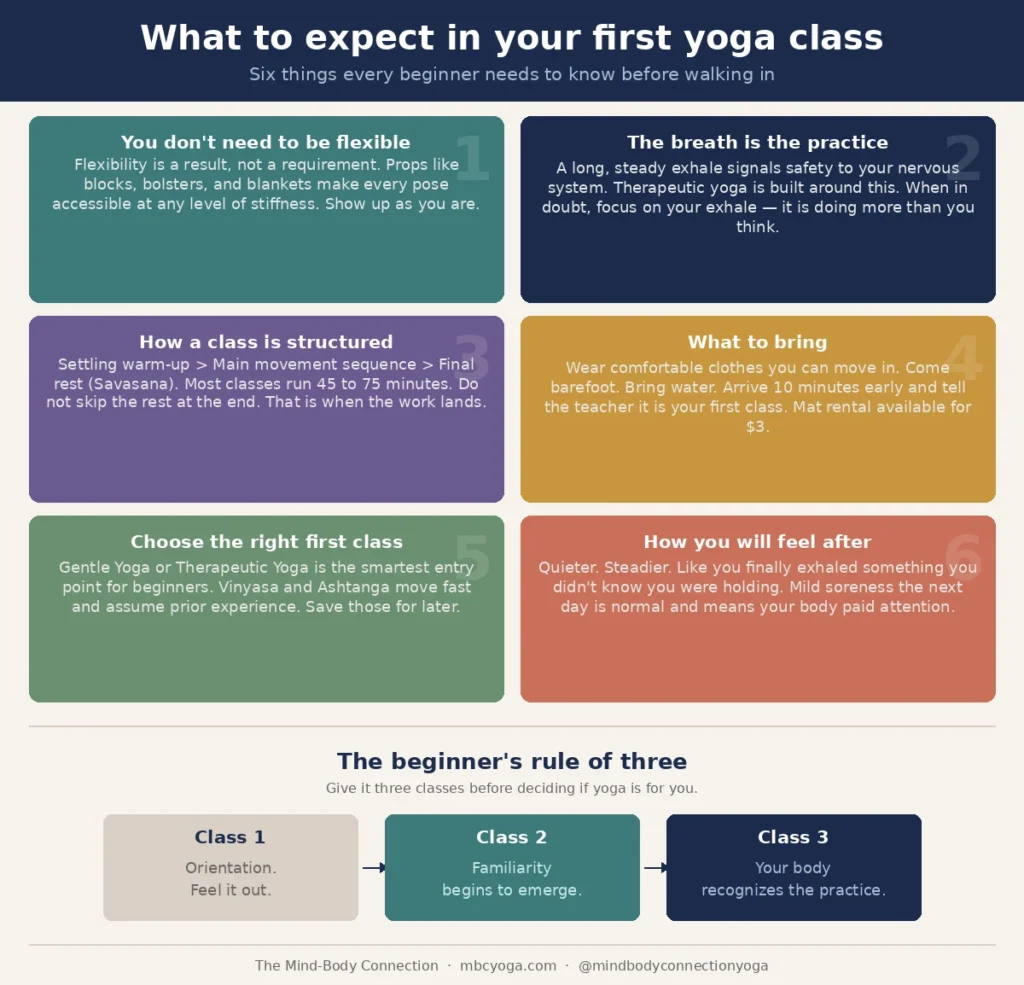
A quick overview of what to expect in your first yoga class, 6 things to know from breath to final rest.
In a therapeutic or well-taught yoga class, the breath is not an afterthought. It is the mechanism. The sequence of movements is designed around the breath cycle, and the exhale in particular is doing significant work. A long, steady exhale activates the parasympathetic nervous system, the part of your biology responsible for rest, recovery, and the sensation that it is finally safe to put something down.
This is why yoga has such a documented relationship with stress and anxiety reduction. It is not mystical. It is physiological. Research on breath-based practices consistently shows that deliberate breathwork can reduce cortisol levels and shift autonomic nervous system tone in measurable ways. The movement in yoga is, in many ways, a vehicle for the breath to do that work more deeply than it could sitting still.
In your first class, you may find the breath cues unfamiliar or even hard to follow while you are also trying to figure out which foot goes where. That is completely normal. The breath practice develops over time. Just knowing it is there, and letting yourself exhale fully whenever you remember to, is enough to start.
The room will probably feel quieter than you expected. There will likely be a moment where you are not sure if you are doing something right. There will be at least one pose that feels genuinely hard and at least one that surprises you by feeling good. Someone near you will look like they have been practicing for years. Someone else will be in the same boat as you.
Here is what nobody tells beginners: the people who look the most comfortable in a yoga room are not the ones with the deepest forward folds. They are the ones who stopped worrying about what they looked like sometime around their third or fourth class. That shift happens faster than you think, and when it does, something opens up in the practice that posture alone could never produce.
One more thing worth naming: soreness the next day is normal, especially in muscles you forgot you had. A hot bath, some extra water, and rest are the right response. If you feel sharp pain during class, that is always a signal to back off or ask for a modification. Yoga is not supposed to hurt. Intensity, yes. Discomfort as you work into unfamiliar ranges, sometimes. But pain is information your body is sending that deserves to be heard, not pushed through.
Not all yoga classes are the same experience, and the style of class you walk into will shape everything. A heated vinyasa class moves fast, builds heat, and assumes a level of baseline familiarity with the postures. An Ashtanga class follows a fixed sequence and has its own culture and tempo. These are not wrong choices, but they are probably not the most useful starting point if your goal is to actually feel what yoga can do.
For a true beginner, especially one coming in with stress, anxiety, physical tension, or a body that has not moved intentionally in a while, a Therapeutic Yoga or Gentle Yoga class is the right entry point. These classes are designed to work with the nervous system rather than override it. The pace is deliberate. The teacher is paying attention to how you are moving, not just what shape you are making. The breath is woven into every transition. You will leave feeling steadier than when you came in, and that feeling is what keeps people coming back.
Wear something you can move in comfortably. Yoga is practiced in bare feet, so no shoes on the mat. Arrive ten minutes early for your first class so you have time to find a spot, let the teacher know you are new, and get settled without feeling rushed.
Most studios provide props. If they offer mat rental, take it your first time rather than buying one before you know you will return. Avoid eating a heavy meal in the two hours before class. Bring water. That is genuinely all the preparation you need.
A yoga mat is worth investing in once you decide to stick with it. A quality mat makes a real difference in grip and cushioning. If you are looking for a reliable beginner option, the Manduka eKO Yoga Mat is a popular choice for its grip and durability, though any non-slip mat will serve you well starting out.
It might. Not every first class is transcendent. Sometimes you spend 60 minutes in your head, distracted, stiff, and wondering what the person next to you is thinking. That is still a useful class. It is showing you exactly what your nervous system does under mild novelty and mild challenge, which is actually the kind of information a therapeutic practice can start working with immediately.
Give it three classes before you decide it is or is not for you. The first class is orientation. The second class is when something familiar starts to emerge. The third class is usually when your body begins to recognize the sequence and the breath work can go a little deeper. Three classes is a fair trial.
Ready to take your first class? The Therapeutic and Gentle classes at The Mind-Body Connection are built specifically for people who are new, nervous, or coming back after a long break. Your first class is just $10. Browse the class options and book your spot here.
What should I expect in my first yoga class?
Your first yoga class will typically include a settling or warm-up phase, a main body of movement coordinated with breath, and a period of rest at the end. The experience varies by style, but most beginner-friendly classes move at a pace that allows you to follow along without prior experience. You do not need to be flexible or fit to participate. A good teacher will offer modifications throughout so you can work within your current range of motion.
Do I need to be flexible to start yoga?
No. Flexibility is not a requirement for yoga; it is sometimes a result of consistent practice. Beginners are encouraged to use props like blocks and bolsters to make poses accessible at any level of flexibility. What matters far more than how far you can stretch is your willingness to breathe, move with intention, and listen to your body. Most people who feel "too stiff" for yoga find that the practice meets them exactly where they are.
What should I wear and bring to my first yoga class?
Wear comfortable, stretchy clothing you can move freely in. Yoga is practiced barefoot, so no special footwear is needed. Most studios provide props, and many offer mat rental if you do not have your own. Arrive ten minutes early, let the teacher know it is your first class, and avoid eating a heavy meal in the two hours beforehand.
What is the best type of yoga class for a total beginner?
For someone with no prior yoga experience, a Gentle Yoga, Restorative, or Therapeutic Yoga class is generally the best starting point. These classes move more slowly, emphasize breath, and offer plenty of modifications. Faster-paced styles like Vinyasa or Ashtanga can be great eventually, but they assume more baseline familiarity with the postures and can feel overwhelming for a first-time student.
How will I feel after my first yoga class?
Most beginners leave their first yoga class feeling quieter and steadier than when they arrived, sometimes surprisingly so. Some mild muscle soreness in the following day or two is normal, especially in areas that do not get much attention in daily life. The effects of the breathwork, in particular, tend to show up as a general sense of having exhaled something you did not realize you were holding.
Key takeaways

You might also like
Which Yoga Is Best for Stress?
People come to me after they've already tried yoga for stress. They took the class.…
What Is The Mind-Body Connection?
Most people have heard the phrase. Fewer can tell you how it actually works, or…